________________________________________
Showing posts with label culture. Show all posts

Thursday, December 9, 2010

African Engagement

Surprise locations, fancy dinners, diamond rings, these are the things that fill the mind of most Americans when they think of the word ENGAGEMENT. But this is a far cry from what most people the world over think of in regards to this word, if they even have such a cultural ideal.

Last Saturday my wife and I were able to attend our first African engagement. One of our church members was getting married and we were a part of the service.

First it most be stated that in Ghana the engagement is the traditional marriage, and can be legally binding. In Ghana there are three types of marriage certificates given by the government. Traditional- meaning that the families have agreed on the marriage, but they not legal bound to stay married and the man can marry as many wives as he chooses. Muslim- this means that the man has had a wedding performed by a cleric and can legally marry up to four women. Lastly the “Til Death do us part” marriage certificate, also now as the Christian certificate, this only allows the husband to marry one wife, and they cannot divorce. With this said, most pastors in Ghana like to have big expenses weddings and will not sign this last certificate unless it is performed at a church, but the truth is that it is possible and also helpful when or if they just perform the engagement and wedding together.

This all stated, Dora, Dennis new bride’s pastor is from a church that they require a marriage ceremony at the church building, so the description that I will give you will only involve the traditional African engagement and a small amount of church influence.


The Engagement-

It starts with arrival at the house. The guest are told to arrive at about 9:00 in the morning the time is not set in the culture, what waiting is. After arrival the guests should expect to wait about one to two hours for the activities to commence.

In this case the hall of the house was filled with about 50 plastic chairs and there were about ten to fifteen outside. The brides family had rented a speaker system to play ‘christian’ music, but luckily for us the power went off after about 30 minutes, and after it came back on Dennis had then start playing more hymn related music.

Close to about 11:00 the brides family arrived. The family elder led the procession, wearing a beauty red, white, black, kente fabric toga. Behind him was the oldest female relate present, and sisters and brother, aunts and uncle of the bride. I believe that the father and mother of Dora have both passed away, since both of them were not present.


The bride arrives (left corner wearing white)


The family then wanted for the grooms family to arrive. This meant about another 30 minutes of wait time. During these hours of waiting the people talk and interact. The veteran missionary has long excepted the use of time and enjoy the surroundings and the way that the cultural works in regards to time. For our kids, we just packed a few small toys in their purses and they had a great time.

About 11:30 our 12:00 the grooms family arrives. They are led by Dennis family elder, the most elderly female, and other brothers and sisters, also friends of the family. Since I was his pastor I was already seated in the house with Dora’s people and pastor.

After everyone in the room is greeted by Dennis family, starting with Dora’s family elder, and moving counter clockwise, then Dennis family sitting in the seats provided for them in the middle of the room.

Then the engagement starts. The brides families ‘okyeame’ or spokesmen stands up. The family elder will speak, but he will not address the man’s family, or the crowd. The elder speaks to the spokesmen, though he speaks in a normal speaking voice, and then the okyeame then addresses the people that he is speaking to. This is very important to cultural protocol. In the king’s court, he always speaks through an okyeame.

The family elder greets the grooms family, and asks why they have come. Then the groom’s family okyeame stands up. He is normally a younger brother or family member of the groom, much like a best man. Each person from the family says their names, and then all the bride family and guest tell their names. The best man greets the family elder and tells him that Dennis has come to take his wife.

When the family elder hears this he ask how they are looking for? The spokesmen then speaks to the other spokesmen and adds some of his humor. It is important in Ghana culture for the spokesmen to present things well, it is his job to insure that the people listening are not offended and want to receive the things that are being said. In this case our okyeame describes the girls of the house like flowers, and tells them that there are many different flowers at the house, and they are wondering which flower the man has come for. The people all laugh at the speakers joke and wit, and now it is the other spokesmen’s job to reply. From here on out, it is more of a competition between the two okyeame. They are free talk at will now, the one representing the brides family, making sure that the man really knows the girl, and for the groom’s okyeame as he tries to so everyone present that the boy is serious and not just picking the first girl he sees. After about 5 to 10 minutes of playful banter and jokes about which flower the boy has come to take, the family elder is satisfied that the boy knows the girl that he loves.

Now it is time for the bride price. As many people here will tell you, they are not selling the daughter (in good families at least), but making sure the boy can take care of the girl and is serious. I will put it in the bride’s okyeame’s words so the reader can see what I mean. The man says, “I know that you have come a long distance, and that your heart is beating in your chest. But, take time and rest, and talk with your family. What things have you carried with you, so that we might now that you can be a husband.” They want to see that an emotion did not bring him only, but that he has prepared for marriage.

At this time the family speaks together, and the groom and the younger men head out of the room to get their gifts. Dennis enters the room again after about ten minutes with his gifts. The grooms best man (spokesmen), then present them to the bride spokesmen. They make sure to take pictures of all these things. The gifts are stated, and then the bride’s spokesmen tell them to the family elder. They included, 1 and a half crates of Malt; two and a half crates of coke, envelopes of money for the father, mother, brother of the bride, and then cloth for the mother. Also a Bible for the bride, and a ring. (In most wedding these gifts can be huge, many hundreds of dollars of clothes, drinks, and money. By God’s grace, Dennis’ wife’s family are more Christian in thinking and did not burden him with a large bride price. Also most family require many bottle of Schnapp, and other hard drink to finish the deal. In older time the bottle of Schnapps would be keep as a pledge, and if the man beat the wife would be returned to bring divorce. But luckily for Dennis no hot drinks were required).

The speaker showing the gifts


The spokesmen then presents these gifts to the family elder. They are talked over in the family, and now a key time comes the family can decide to take these gifts that were predetermined our add something to them. If they do, no matter the amount of cost, they must be fulfilled or the engagement will not continue. The family elder smiled in this case, and then spoke to the spokesmen. He turned to the groom family and said… “We see here gifts, but how can a girl wear a Bible and how can a ring cover her, do you have more to add?”

This was a good respond, but all the other things that Dennis had bought for the bride were at the house, and he did not have them with her. So the family asked to leave and they would discuss this development, I left with the family at this time, and Dennis the groom, just looked like he wanted everything to be over, so he could see his bride. (Remember the bride is no where to be seen at this time). After discussion, we all return from another room, and the groom’s spokesmen, tells the bride’s man that the gifts are at the house. He begs that they not be forced to be brought. (This case the family gives grace, and the wedding continues, but if they wish they could have made them go and get all the things, in this time the spoken and elders agreed that after the engagement, the speaker would take his vehicle and go to the house and check to make sure everything was present).

Now that the price and everyhitng has been excepted the grooms family elders greet the bride’s family, and give them thanks. In sign of respect the elderly people lower the clothes off their shoulder, much like removing a hat, and shack the oldest man and woman’s hands.

Dennis accepting Dora


Now the bride can be called. But where is she. The groom’s spokes men ask to be able to see the wife, he has paid the debt, and now wants to see the girl. At this time, the uncle have an opportunity. Traditional the uncle would get some money, but not as much as the father or mother, and a certain fact of procedure gave them an opportunity to make some money. In the olden days the girl was not allowed to stay at the home if the family knew a boy was coming to marry their daughter. They did not want her to beg for lowly dowry or for the boy to try take her by force if there was a disagreement. For this reason she was sent to a relatives house, as near or faraway as the family deems important. This gave the uncles their chance to gain a larger gift before the wedding. At the engagement, the spokesmen for the girl, normally her uncle, will tell the young man’s family, that the girl is not here, and that he will have to send someone to get her. This being a case, transportation will have to be provided for the trip.

Me praying for the couple


(In this case, the men joked about if she was in Temale, or Tema, of Wa, to which the man’s people pointed to the far bedroom, and told him that he was in Temale. The uncle then asked for a plane ticket fair, and the man handed in 10 cedis. (about ten dollars) and to this they called a young girl to call the bride. Of course the uncle look as if he gave the money to her, but took it back).

Finally the bride was allowed to come. She was dressed al in white, but not the formal white dress of the church wedding, but a nice locally made white dress. At this point the bride family asks the bride if she will accept the gifts. They ask here about three times to make sure, and then the groom and bride are allowed to sit on a couch together. At this time, the elders from the family give advice. The men remind Dennis that he has married her, and that he should not raise a hand to bet his wife and to be a good husband. The women challenge Dora to be a good wife and obey her husband.

At this time the women’s family elder handed over the serve to Dora’s pastor. Here he preformed a small ceremony, (if he had chosen he could have completed a full marriage ceremony, but he chose to have a small time of Dennis giving a ring, and to invite the people to his church the following day for the wedding). Here all the pastors that were present gave a charge to the couple and directed them to try to start the marriage well.

Dora getting her ring


I was given the opportunity to speak, and since I would no preach at the other church for doctrinal and other practical reason, I used this time to say some words of encourage to the couple.

After the speaking, the family opened all the cokes, and each person was given some food. Sometimes this can be very expensive, but Dennis wisely purchased a small amount of meat and a small meat pie for each person; still expensive, but not as high as it could have been. After eating the engagement was over and people were free to leave and take picture.

And this ends the long description of our first African Engagement. (Sorry for so few pictures the lighting was bad).

Monday, October 11, 2010

Cultural Tidbits and Taboos

On Saturday our family had another one of those funny and not so funny cultural moments. Patty and I have been witnessing to a lady for some months now. She is educated and speaks English and Twi quiet well, and has been exposed to many foreigners through a job program that she has been a part of in years past, but she is still very traditional in here thinking.

On Saturday we were reviewing the materials that we have covered with her in the past, since she has been in her home village for the last few weeks. The Bible study was progressing well, and Esther (the lady that we witnessing to) had given the girls some paper and pens so that they could draw pictures and color while we had the Bible study.

Esther was listening really well, she seemed to be remember a lot of the material and was understanding new things that she had not grasped before. During this time the girls were have a great time drawing. I had just finished talking to her about the fact that all the gods and things worshipped here, bring a curse though they have powers, because of Exodus 20 and Genesis 3 when Carey walked over to show us the picture she had drawn.

First I want to say that Carey loves princess and fairy tales. She had draw a scene with an ocean and fish and a nice clear picture of a mermaid in the middle of the picture. Just as I saw the picture, my brain clicked, and I saw Esther's eyes get Huge!!!! I sent Carey away nicely and told her to draw another picture.

Then the explanations began. See in Europe and America mermaids are fairytale fodder and at most a superstition of years past. They were believed by sailor to be beautiful things that would help sailor that were throw over board and so on. And modern American has really fallen in love with them since Disney's Little Mermaid movie. And Carey being a total girl, loves all things that have to do with fairy tales and princess and draws pictures of all these things all the time.

But in Ghana, this is not the thinking. In Ghana mermaids are demons! They live in the rivers and lakes and work to curse people and work evil. The queen of the mermaids is Mame Water, and she is a witch and is greatly feared by people. When ever they make local movies here about mermaids and such they always agents of evil and most people think they are tantamount to the evil eye or bad omens.

So needless to say it would be like your pastor coming over and having a Bible study with you, and then the Pastor's kid comes over with a drawing full of pentagrams, and goat heads. Lets just say I was glad that Esther had been around other foreigners. After a few minutes I was able to explain the thing, and was kicking my self that I had not thought of it earlier.

Well, after visiting we got to explain to Carey and Ella why they could not draw pictures of mermaid when they are not at home anymore, or when Ghanaians are around. Carey looked at me and said, "Daddy but that is silly? Why be afraid of that, God protects us!"

It is very interesting raising children of the mission field. They learn somethings so early. The learn many cultures, and beliefs, and have to be sensitive to each one in the right way. But, the truth is that it can be a great help in the future. Missionary kids are one of the few kinds of people that get to learn many different tidbits and taboos from many cultures.

Thursday, September 2, 2010

Using African Proverbs

The other day I read an article that expressed quiet well a fact that I have seen lately in my preaching. Since the book was write and complied by Africans, it helped to reinforce my current views as being not only heading in the right direction, but also good for national believers.

Often I see African missionaries start to compromise, even as I write I think of one that I went to Bible school with. They start making statements like, "My message is not reaching the people, they say we are to foreign!" Which many times is true. But, the new missionary begins to look in the wrong places for help. Instead of taking time to learn the positive sides and deeper things of the culture, they make the early easy decisions. I think many people in our movement would be surprised about the amount of compromise that happens on the African mission field in the name of making thing more local. But most of these ministries are just groups that are controlled and planned by foreign thinking and are covered with a thin layer of local dance and drumming. (I am amazed how often people that I know excuse things because of geographical location). The truth is that the music is the first to change, but after this point the ministry makes no impact in the lives of most people in the group. The unsaved that attend will not complain because their felt needs are being meet.

Here is the article. I hope it is helpful. I wanted to quote a large part of it, because I wanted the reader to hear these truths from another person. I will make a few application points after the quote.

AFRICAN PROVERBS
TONGA PROVERBS FROM MALAWI
David K. Mphande

Joshua N. Kudadjie, Series Editor

General Features of African Proverbs
Much of the language and thought of Africans are expressed in proverbs. In many ways, African traditional proverbs are just like those of the people of other cultures and races. Like others, African proverbs are short sayings which contain the wisdom and experiences of the people of old. Although there are also long proverbs—which look more like short stories or poems—the overwhelming majority of African proverbs are short, pithy statements.

Scope and Content
There are thousands, perhaps millions, of African proverbs. New ones are still composed, and old ones are adapted or given new meanings to suit new situations. Anyone who is ingenious—that is, one who is creative, observant and has the ability to reflect and deduce a moral lesson from common happenings—can compose a proverb.

African proverbs contain observations gathered from common everyday events and experiences concerning the nature, life and behaviour of human beings as well as those of animals, birds, plants, and other natural objects; and even supernatural objects and beings. Some of the proverbial sayings are statements of historical facts about the people, while others contain information about their culture. For instance, the Ewe proverb, “When Nôtsie chief sends you to war, you yourself have to find a way of hiding from your enemies,” tells of events in their history some 600 years ago when many Ewes lost their lives in wars that they fought for the chief of Nôtsie (an ancient walled city situated in present-day Togo). A great number of them express their philosophical thoughts, religious beliefs and values. The Akan proverbial saying that “God pounds fufu for the one-handed person” is a theological statement of their experience of God’s provision, loving kindness and gracious dealings with humankind.

Other proverbs reflect the social structure of traditional African societies. For example, there are proverbs that suggest how to deal with elders, children, a spouse and so on, and there are some which indicate the position and role of various members of the society. The Ga proverb: “When a woman rears a goat, it is a man who slaughters it,” shows the position and role of the woman in Ga traditional society as a subordinate but indispensable companion and partner of the man. Similarly, the Dangme proverb “The stream side drinking gourd does not make one die of thirst” (i.e., it saves one from dying of thirst), shows the importance of women in the created order; for it means that a man who has a wife at home will not die of hunger. At a deeper level, it means that a man finds his complement, his fulfillment in woman, a wife.

A close look at African traditional proverbial sayings shows clearly that the main concerns expressed in the proverbs relate to every aspect of human life. The ultimate purpose of the proverbs is to teach wisdom and moral lessons. Thus they contain, and are used to convey, moral lessons and advice on how to live a good and prosperous life.

The proverbs touch on all conditions of life: wealth and poverty, health and sickness, joy and sorrow; occupations: farming, hunting, fishing, building, trading, and so on; and other kinds of activity: healing, cooking, walking, sleeping, marriage, childbearing, upbringing, etc. There are proverbs which speak about and to all manner of people: kings and citizens, nobles and slaves, women and men, children and adults, apprentices and master craftsmen, and so on.

African proverbs contain observations and good counsel against undesirable vices like anger, backbiting, greed, ingratitude, laziness, lying, pride, procrastination, selfishness, stealing and so forth. The Ugandan proverb, “Anger killed a mother cow,” warns against anger, while the South African proverb, “Horns which are put on do not stick properly,” condemns hypocrisy and arrogance. Many other proverbs also praise and advise people to cultivate virtues that promote progress and ensure well-being; as for instance, circumspection, co-operation, gratitude, humility, patience, perseverance, prudence, respect and unity. The Igbo proverbs, “The palm wine tapper does not say everything he sees from the top of the palm tree,” and “If the mouth says the head should be beheaded, when it is beheaded, the mouth follows it,” both teach prudence and the need not to speak just anyhow or say everything one sees or knows.

Context and Use
In traditional African society, one can hardly hear anyone speak a few sentences without citing a proverb. For the initiated, the citing of proverbs comes naturally without any conscious or special effort. This is as true during ordinary conversation as during formal and solemn discourse. However, proverbs tend to be more purposely cited during serious or formal discourse, such as during proceedings of the council of elders, a chief’s court, an arbitration, family meetings, or during exhortations on how to live a morally good life.

A cursory examination may suggest that some proverbs contradict others. For example, some proverbs counsel self-reliance, while others counsel community effort. The truth, however, is that in their own contexts and particular situations, each is apt. In real life situations, too, there are paradoxes and apparent contradictions. For instance, in certain situations, the best thing to do is to be silent, while in others, speaking out is the wise thing to do. Thus, although silence and speaking out may appear conflicting when put together, in the appropriate contexts, each is positive. It is no wonder, then, that since proverbs relate to real life situations, they sometimes seem to conflict with each other; but they are only apparent and not real contradictions. This fact underscores the need to use proverbs in the right context and appropriate situation.

It is also important to note that one proverb can have several meanings and can, therefore, be applied to different situations. For instance, the Ga proverb, “If you want to send a message to God, tell it to the wind,” can be used in different situations: to teach that God is everywhere; to teach one the correct Ga procedure that if you want to see the chief, you must first see the linguist; or to advise that if you have a bothersome matter that you cannot speak out, you have to tell it to those who can pass it on.

On the other hand, in some cases, many different proverbs teach the same moral lesson, and can, thus, be used for emphasis. The Ga people say: “A kitchen that leaks (or a shed in ruins) is better than a thicket.” The Ewe have a proverb which says, “Even a good-for-nothing fellow can carry a pot of palm wine to the funeral.” The Dangme say: “Mud-water also can be used to quench fire.” All these proverbs teach the same moral lesson, namely, that every person is of some use; therefore, everyone should be given
due regard, and people should have a sense of their own worth and be contented with what they are.

African proverbs can be used for several purposes. They can be used for the linguistic analysis of a particular language or dialect. Historical information as well as the thought, customs, beliefs and values of a society can also be obtained through their proverbs. Besides, African proverbs are a literary device used to embellish speech. This is because many of the idioms of an African language are embedded in its proverbs. As it were, African proverbs are used as sweeteners to communicate effectively. As one Ga writer (E.A. Nee-Adjabeng Ankra) put it, speaking without citing proverbs is like eating soup that has no salt in it. Proverbs are cited to confirm, reinforce or modify a statement; or to heighten and attract attention to a point or message; or simply to summarize a speech. Sometimes, too, they are used to communicate a fact or opinion which it might be impolite or even offensive to state in direct speech or plain language. They are also used to make people appreciate speech, or facilitate understanding, and lead to conviction. As one Yoruba observation has it: “ A proverb is the horse which can carry one swiftly to the discovery of ideas.”

Although all these uses are important, they are, in fact, means to an end. The ultimate purpose of proverbs is to impart wisdom; teach good moral and social values; warn against foolish acts; provide a guide to good conduct; and to influence people’s conduct and help them to succeed in life.

African Proverbs and the Mission of the Church

African proverbs can be extremely useful and effective for all these purposes, particularly as a tool for teaching moral and social values, and how to conduct oneself successfully in the business of life. They are short and not easily forgettable. They are also popular for their humour. Moreover, they provoke vivid images in the mind, such that things that are otherwise abstract and difficult to grasp become relatively easy to understand.

Proverbs have the power to change people’s conduct, because the truths portrayed in them are so plain and unchallengeable that those who understand the morals and advice they contain, feel compelled to conduct their lives in the manner prescribed in the proverbs by the wise elders of old.

It cannot be doubted that desiring to live the good life is not enough, for one can know and even will to do good, and still be unable to do it (see Romans 7:14-25). It is those who accept the gospel of Jesus Christ and have the Holy Spirit in them who have power to do the good. Yet, it is important to note that Jesus Christ who brought this new power to work from within a person, himself also used the method of influencing people from the outside by appealing to their minds and hearts through teaching. In doing this, he used stories and proverbial sayings. There can be no doubt, then, that the present-day Church may attain its goal (which is to make all peoples the followers of Christ and teach them to obey what he has commanded), if it encourages the proper use of proverbial sayings. In using these indigenous proverbial sayings, however, the Church must correct and replace what is not so good in them, and add on from the Scriptures what is more excellent.

At this point in Africa’s history when there are cries everywhere for moral and social reform, the use of proverbs in moral education is urgent. The many positive features of African proverbs, such as those cited above, make them most invaluable and unavoidable as instruments of teaching. The Church which has always been interested in people living the morally good life, must use African proverbs even more earnestly, especially in preaching and teaching. Their use will help immensely to teach the truths of many biblical themes and stories, and to affect the moral, social and spiritual lives of the people for the better; for when a proverb is used correctly, it speaks to the intellect, the soul and the heart—that is, to the understanding, the feelings and the will. Over the centuries, African proverbs have successfully done this. They can, thus, be used to great advantage in Christian preaching and teaching.

I realized while reading this that this is why many of the teachings of Christianity have not taken root in believers lives in American and Africa. Though in America we do not classify our teaching in proverb form, teaching that changes lives still follows the practical reasoning behind proverbs.
I have come to see that most Christians that live out their lives in a practical, real, daily way, have been thought how to put the truths of the Bible in bite sized pieces that they use in their everyday lives. If you ask them why they do or do not do something, and it is really not just because they are copying something they do not understand, they will give you a short principle, truth, or command from the Bible that has guided them in this choice. (i.e. - why I should not smoke? My body is the temple of the Holy Spirit and I should take care of it, so on and so forth).
But what hit me while reading this article was that along the line in Africa, we missionaries have failed to give the local people Christian proverbs (thoughts, principles, teachings) to guide their lives by. Things have been presented in such a scientific or foreign way, that it has been hard for most of the people to have maxims to live by.
For example my wife visited another national lady a while back. Her husband runs a large national Fundamental Baptist church and trains pastors. While visiting the wife, they went over to the church to see the new building that the church had built. There in the building was the notes from Sunday school. The black board had not been erased. (These lady is constantly telling my wife tha thte people do not understand the teaching and are not changing).
The board was full of Bible college notes. Line by line of college theory. (To be honest, my wife and I have trouble understanding that stuff). That was his lessons. See most people teach how they were thought! The reader might say that that is just one example and should not be sited as proof, but I have seen that same thing happen with other nationals trained by totally different missionaries.
The point is this... if we are going to teach Christianity in a way that will touch and change the average Africans life: socially, culturally, spiritually, then we will have to use the medium that has been set and used for ages to do this very thing: THE AFRICAN PROVERB.
As the missionary strives to learn the language and teaching styles of the people he is working with, one thing will come back again and again. If he will have to use Proverbs: new, old, or inspired (The ones in the Bible) If he does he will find that the teaching will move from simply being something for Sunday to something that can been applied by all the believers.

Monday, August 9, 2010

Teaching Oral Learners (IIliterates)

Orality refers to the style of communication between individuals and generations that functions without the use of a writing system. However, it is a deeper concept than the mere absence of writing. It produces its own thought forms and processes that constitute ways of learning, conceptualising, and communicating that are quite distinct from those of literate thinkers and communicators. Oral thought processes are less linear, and logic is associative rather than deductive and sequential. Orality also affects worldview, particularly in the area of truth perception. For literates “truth is seen as consisting in facts... An oral culture is characterised by relational, face-to-face communication using stories, proverbs, drama, songs, chants, poetry and others forms of participative, communal and interactive events. - Quote from Missiopedia.

I have found this quote to be quite true. The longer that I work with people that are not literate, partially literate, or post-literate (someone that reads and writes but mostly uses others means to learn and communicate) I see that their oral thinking makes them very different to reach.

The first time that this idea really hit me was just a few months ago. I have worked with partially literate people for year here in Ghana, but it is harder to see the difference in these groups. Partially literates are better at hiding the fact that they do not understand, since most of them have been placed in circumstances with mostly literate people. The night I finally relieved the important of understanding how to teach oral learners was not an easy experience.

I was at the shanty village in Kaase, trying to teach on the difference between evil spirits and the Holy Spirit. (Many groups and people here give the Holy Spirit credit for actions and powers that the Bible says belong to demons). Most of the lesson was deductive. I would give examples from the Bible of people with demons and show how they would act. Then showing the people what the Bible says the Holy Spirit will do, I would logically try to compare the two and help the people deduce that what was happening today in many groups was not the Holy Spirit but evil spirits. Well, lets just say will teaching I noticed more and more people starting to get that glazed over, what is he talking about expression. By the end everyone was lost!

I realized while preaching that night; after seeing people holding their song books upside down, and seeing that most of them had never been in a formal teaching atmosphere, that the ways I have taught in other areas, where not going to work. It was time to go back to the drawing board!

I had to relearn how to teach. I knew how to teach people that were used to a Western thought progression, but what about people that had never been to school, people that did not know how to read, that did not think like readers.

I started to ask myself, "How do people in the villages learn?" After some time of thinking I came to some early conclusions. Most people groups in the past, and many less exposed groups today, rely on oral tradition to teach and communicate to the newer generations. This is why many cultures are losing their history and worldviews (The kids don't want to listen to the old people anymore). Though times are changing most still learn best in these ancient forms. (As I thought about this, this seemed also to be Christ's favorite mode when teaching the common people. Questions and logical debates for the educated, and story telling with moral lessons for the uneducated).

I knew that I was teaching the Bible. The Bible was what was needed to change the people, but maybe the approach or style of teaching was the problem. To find some council, I began to do some research.

After trying to find sources, I was able to find many people that have come to understand that teaching oral learners, and post-literate learners is very different from teaching readers. Here are a few quotes...

George A Kennedy in Encyclopedia of Rhetoric
A complex chain of logical arguments is not a feature of persuasion in non literate societies. Argument from examples - mythological, historical, experiential, or analogical- has probably been the most common form of reasoning all over the world, and proverbs are a basis of demonstration in many cultures, though often universal propositions are not articulated.

There is much repetition in most traditional speeches and little explicit logical reasoning , though references to myth, legend, history, and proverbs may supply examples of what should be done in support of the speaker's proposition.

John S. Mbiti in African Religions and Philosophy

"Proverbs are common ways of expressing religious ideas and feelings... It is in proverbs that we find the remains of the oldest forms of African religious and philosophical wisdom."


Charles H. Kraft in Christianity in Culture


To relate the message to the real life of one's hearers, the communicator must learn to employ the communicational devices familiar to the receptor in ways to which the receptor is responsive. Credible messages start from where the receptor is. In many cultures this involves the knowledge and use of a variety of proverbs, aphorisms, and tales of various kinds. Such literary devices form important vehicles within their communicational system.

These quotes should help the reader to see that to communicate to an oral learner is a totally different process then dealing with someone from a social group, society, or culture that is greatly influenced by literacy.

I realized that if I did not find a way to communicate to these people then most of what I was teaching would be lost or misunderstood. So, I decided to focus my teaching more around Bible story telling. Using the story and experience of the Bible to convey the Bible truths that I was trying to teach about in theory.

I began to see that most of the Bible is written in narrative forms, with another larger amount being written in prose and proverbs. I mean proverbs must not be a bad thing, God took time to inspire a whole book of them for us. It dawn on me that if I would teach the Bible in story form and move to the deeper more complex matters later on (the ones that needed to be deduced from facts), I would have a better response. The funny thing is that this is just how God wrote the Bible. As Western Christian we like to jump over most of the Old Testament and get to the real 'meat' of the epistles. But, the interesting thing is that I think this is harmful for most new Christians or people not exposed to the history and stories of the Old Testament. It is like giving a nervous system with out a bone structure or muscle to hold it up. Lots of feelings, but no strength.

Though most of my education in hermeneutics rebelled at these ideas. No more three points, an application, and illustration. I knew that this was necessary. Some were a long the line our Western education has greatly infected our churches, and many times does not produce the strongest Christians.
It used to be that most churches used the early years to teach the Basic stories of the Bible to children. Building from creation to Abraham, Abraham to David, David to Jesus. They would use each story to teach one or two truths about God and His word at the most. Also many groups used catechism to teach. Basically these where books of little truths (or proverbs if you will) to let children know what was believed at the church. But today, this is not the case! We say, "Kids don't need stories they need application"! So most Sunday school curriculum for children is more like a dumbed down high school theology book. State the doctrine, a proof verse and then 80 little stories from little Jimmy's life.

Well enough with the rabbit trail, the truth is that this approach does not work well with oral learners. The leap from the theory, to the practical is to wide. The truth then becomes some idea from a strange group of people. When a person communicates in a form that they have used for centuries, it suddenly makes the Bible to be practical and understandable.

For this reason I have changed much of how I teach. On Sunday for the last year we have been progressing through the Bible. Starting in the Old Testament and working into the new. Each story has just one application. The application is put into proverb form (if I can find a local proverb that communicates this Idea, then it is used). The stories are told with this one idea in mind. I seek never to distract the reader from the main theme. Though each Bible story can have many application, we try to stick to the main theme and most practical application of each story. This proverb is repeated again and agin, so that the mind records it and is able to use it late. Here is an example for the reader:

While reading the story of the problems of Jacob and Esau- we taught about dealing with problems and seeking restitution (forgiveness). A local proverb fit perfectly. "A loose tooth never rests until it is pulled out." It conveyed to the people that no problem is fixed until they deal with it. This proverb was stated at the beginning, and restated repeatedly through the teaching. The story was read from the Bible in the beginning to show its link to the Bible and the Bible's authority, but then the story was taught in story form using visual aids to help.

In our Wednesday night meetings I follow much the same process, but I use collected stories from the Bible to teach truths about the gospel in an effort to show the people their need of salvation. I try to supply a proverbial truth (weather newly developed by me the missionary, or an ancient part of the culture) to help these non-readers to remember the lesson. Remember these people cannot take notes and then re-read the passage at home. The only thing they get to take home with them is the truths they can remember.

This ideas has even shown me the importance of using non literate tools with people studying for the ministry. Though a person here will not be able to be in the ministry without being literate and have a grounded education. They still learn and gather facts in much the same way that a non-literate person does. This is why many students of theology in Africa do not understand many points of doctrine and seem to loose course when moving from theory to practical in African life. Though there will need to be a structure and pattern to follow that is copied from the Western school system, the mode of teaching and style of teaching should be modified to best equip the student for real life ministry.
Most missionaries just jump into classroom style lecturing with converts that express interest in learning the Bible, but many do not first try more circumstance oriented teaching. This is the style that Jesus Christ used with his disciple most often. Not to say that Christ never had set times of teaching, but he taught most of his truth when a question would arise or a circumstance would present a good case for learning.

I have to admit this form of teaching is much harder on the missionary to be disciplined. He has no course written out, and no list of classes completed, but if he is diligent and has written out what ideas and teaching needs to be taught, he will be amazed how much can be conveyed in a non-formal classroom setting. Not to say that in time, there will not be formal classes. But I think that most of the practical training and teaching can be given in these ways. Once a person has been grounded and has a solid foundation, then they can be given a time of practical and formal training in a more Western style. (This will help to prevent people that are trained only for an institute certificate and not truly grasping the life changing teaching of the Bible).

Over all I challenge any person currently teaching people that are illiterate or influenced by oral culture to try to investigate a new form of teaching style. Try to ground the lessons in story form and to develop them around a single truth. Find meaningful ways to communicate the one truth you want to teach and try to make the teaching interactive to see how the lesson is being received by the hearer. I hope and pray that if these idea re followed, the reader will find as I have, that the teaching of God's Word is more impacting then before.

Thursday, July 1, 2010

A Word Fitly Spoken...

A story is told of a young man, sitting by the river bank, discouraged since he could not swim across the river. An elderly man walked up, rolled up his pants, and then walked across the surface of the water. The young man was in disbelief until another elderly man arrived, rolled up his pants, and also walked across the surface of the water. Eventually, a third elderly man arrived and did the same thing! Finally, the young man decided to try for himself. He rolled up his pants and tried to walk across the surface of the water – only to sink and be carried away by the swift current. The three elderly men looked back and replied, "If only he had asked us – we could have told him where the stones were placed to cross over the river safely!"

When approaching oral cultures, proverbs can be regarded as these sturdy, time-tested stepping stones placed by the elders to move people from the river bank of unbelief or young faith to mature faith. - - W. Jay Moon.

These last few months, the Lord has shown me the important of learning and using African proverbs. In the seven years that I have been here, many times as people find out that I speak Twi, one of the first things they ask me is if I am able to speak proverbs.

I have learned that it is a very important part of communication and is seen as a sign of wisdom and the ability to properly communicate. My wive has recently bought me a book of Akan proverbs. It contains over 8,000 of these proverbs in Twi and English.

The more that I work with the people here the more I see the important of these proverbs. They are the way of saying the truth when it would be hard to be blunt. It is a way for people that cannot read to remember what was said in a easy way. Also it opens a storehouse of understanding into the way the people in this culture think.

Luckily the Akan people have one of the strongest recorded history of their local proverbs and saying. A missionary recorded the first group of African proverbs every written in the 1890's and his people group was the Akan. This effort has greatly helped the Akan people in there use and ability to remember this verbal tool of the culture.

Some examples of Africa Proverbs-

"When a frog comes out of the river and tell you there is a crocodile inside, it true!" Meaning- heed the voice of experience

"A log may soak in a river, but it will never be a crocodile." Meaning- not matter how long a fake tries, he will never be the real thing .

"A long rope is easily entangled" Meaning- to much talk ends up in trouble

"The old women feeds the chicken, so the chicken can feed her" Meaning- people can do good things because they know good will come out of it in the end.

"If the head is present, why then is the hat wore upon the knee" Meaning- when an older person is present it is not appropriate to give the responsibility to a younger person.

"An alligator solves its problems in the river and not in the forest." Meaning- there is a proper place and time to solve any problem.

"It is because of hurried eating that the monkey did not grow fat" Meaning- a person that does not sit down and plan things well and does not do things right they will not gain anything.

"The benevolent husband cannot give his wife as a gift" Meaning- a man cannot give some things no matter how good he is.

"The left hand washes the right, and the right washes the left" Meaning- "I scratch your back you scratch mine", but without the idea of it being for a bad reason. People need help.

"Monkey play by sizes" Meaning- young children should know their place and be respectful.

"The man who does not tell his neighbor that there is sickness in the soup, will not sleep at night when the neighbor is cry in pain" Meaning- when a person does not tell a friend they are doing wrong, in the end it will effect them also.

"When the elephants fight in the bush, it is the grass that suffers" Meaning- when parents or leaders fight, it is the children or followers that suffer the most.

"The length of a frog can only be determined after it dies." Meaning- don't judge a person's live until it over.

"In the village of the blind, the one eyed man is king" Meaning- those that do not know better will be lead by those that are not the best choice.

"If nothing touches the palm-leaves they do not rustle" Meaning- were there is smoke their is fire.

"A loose tooth will not rest until it's pulled out." Meaning- a matter will not be solved until it is dealt with.

Monday, June 28, 2010

The American Spirit

Some people have asked me, which team I was rooting for this week. Ghana played United States in the round 16 level of the world cup. Some Ghanaian thought I would root for America, and some missionaries were made that I did not!

But I think it is all a matter of the American Spirit. Sure if the U.S. was playing any other team, I would be wearing my Red, White, and Blue, they are my home country, but not this game. Some people are shocked when I tell them. But, I think that I have found a way to explain my treasonous behavior to those other missionaries that are slightly offended by cheering for the 'other side'.

See, one of the truest and most deeply rooted believes or habits, what ever we call it in America, is that we cheer for the under dog. We all want to little guy to win, the under achiever. We love the stories about the guy that comes out of no were and wins it all. Well, that is Ghana's story. It is a small African nation, with only 20 million people. It was facing a Goliath nation of 400 million and millions more in funding for a sport that most of its people do not even like.

So I cheered for Ghana! In this case it was the truly American thing to do. And I might add, David defeated Goliath two goals to one! (It is funny how we like under dogs until we are the big dog).

Weather the reader was cheering for the US, Ghana, or did not even know about the match like most people in the 50 states, it was fun. And this missionary had fun watching a game in which no matter the out come, he could not lose.


Sunday, June 13, 2010

The New Adom Hene (King)

A few weeks ago I was in down town Kumasi, when I heard gun shoots. Crime is very low in Ghana, and in 7 years I have never heard gun shoots. Needless to say I was surprised. So what did I do, the reader might ask? I went to go find out who was shooting the guns.


I found out that the new Adom Hene was being given the throne on that day. Here we call it en-stooling, since the king has a stool instead of a throne. The Adom hene is the king in charge of protection for the Asanti Hene and he is the general in charge of warfare if there ever was a war.

In the pictures, if the reader looks closely, he will see that the king is holding a small shotgun. The soldiers are all carrying guns or golden swords. It was quite amazing. The men leading the king were in possession of 12 gauge shoot guns and where shoot blanks. The area that they were passing through was the busiest part of town. Thousands of people were watching. The procession blocked the roads, and people were lining the roads to watch. I grabbed my camera and tried to take a few photos.

It is hard to express, but the recoil from the shooting of the guns, as it bounced off the three store builds was pretty intense. It reminded me of a few military shooting ranges that I have been to back in the United States.

The king was riding in a 'palanquin'. It is a four foot long low sided box. The palanquin has four carrying polls attached to it. One poll on each corner. The palanquin is carried by four people, in former days these were slaves, but now they are people that work at the chief's home. The king body is covered in amulets and charms. Some are used to give him power, others are used for protect. He is given a new name on the day that he becomes king. It is believed that when he picks the stool, the spirit of the departed king comes to live in his body. Also the kings mouth is filled with clothes, traditional medicine in a pouch, and leaves. He is not allowed to talk! From the beginning of the process until the end he may not speak.
The sounds of the drums are almost deafen up close. The talking drums are being played, and they are used to praise the new king and the departed kings of the past. Many of the people are wearing black. This is because in choosing the new king they are also remembering the former king that has died, therefore they wear black to show respect for the departed.
As the king and the soldiers moved down the streets of Adom, they would stop from time to time. This would allow the people to see the king. During this time they would spin the umbrellas and everyone would begin to jump up and down. They would point to the king and praise him. The whole procession was a long drawn out affair of drumming, shouting, shooting, and cheering.

Monday, May 31, 2010

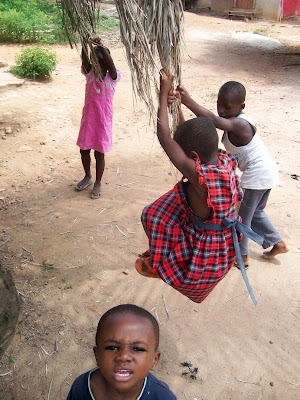
A Local Swing Set

Last Wednesday, while we were waiting for our friend to come for visitation, our kids went to play with the other children. Here is what they came up with... a local swing set. Our at least a Tarzan version of one.


Please click on this photo to see how high Junior is swinging! He is in the middle of the pictures holding on for dear life!


Monday, April 26, 2010

A Muslim Wedding

Sunday afternoon I had the opportunity to go to a wedding. This was my first personal invitation to a Muslim wedding, and I was very excited to see how all the parts worked together. The formal cultural engagement (this is the time when the two families sit down, and the young man pays the bride price) occurred at 9:00am in the morning. Unfortunately this was the same time that my family would be heading to church, so I had to miss out. But, after church I had the opportunity to attend the after engagement and the more modern time of the wedding party. This is the time where the community comes to welcome the bride and groom, and give them their gifts.

The first thing that happens when a person goes to this kind of wedding, is the greeting of the bride. (I did not get to greet the groom, he must have been taking care of a few last minute things). The bride was located in a small room off the main courtyard. Here she is surrounded by her sisters. They make sure to allow everyone time to greet the new bride. Each person complements the bride, wishers her good fortune, plenty of children (hopefully sons), and the opportunity to be a good wife!
The bride has prepared for at least two days for her wedding. (Many Ghanaian Muslims are not strict followers of the Hadeth, so there women are not forced to cover their faces. Most are content if the women only wearing some form of covering on the head).
In Northern Ghana many of the Muslims tribes follow the culture of painting the bride hands and body on the wedding day. They first rub the skin with henna. This makes the skin a very bright reddish brown. Then they take a black dye called 'kohl', and begin to draw designs on the body. Modern times have added new things to these. Now many have fake nails applied and have their hair breaded or woven for the wedding.
After greeting the bride it is time to move to the compound of the house. This space is filled with women and children. They have a tent set up to block the sun. Some women are making food for the celebration, others are complementing the mother. Still others are just sitting around talking and laughing. The place is a sea of head coverings, brightly colored clothes, and children.
Here are a few pictures of some of the babies, children, and women in the inner courtyard.


Inusah's mother. She is the third wife of her second husband.
After greeting everyone inside and eating some food with Inusah in his room, (I think I forgot to mention, the wedding was for Inusah's younger half-sister) our group of guest headed outside. On the street outside the house, there are two large tents set up. There is a long table covered in white fabric and large speakers playing very loud music.This music serves to entertain everyone and to tell the community that a special event is happening. Under the tent all the men are sitting. Waiting. They are talking and fellowshipping. Also with these men are the other guest, ones that are not so close to the family that they are allowed to remain inside after greeting the bride. Overall the outside is filled with patient, as everyone waits for the groom to return, and for the celebration to begin.


The party will last most of the day. Their will be dancing. (Strict Muslims, will only allow the men to dance with the men and women with woman). There will be eating, singing, and mostly likely a little drinking. Though Muslims are not supposed to drink, many men will sneak off to the local bars and drink. So will fill their hand washing pots with local brewed liquor, and while some go off to pray, will drink the contents. Overall a few will be drunk by night, and after many hours the bride and groom will leave to their house.

For our little group, the wedding ended quickly. After greeting, eating, and giving gifts, it was time to go. It did open up some good chances to talk to a few of our young people about Biblical dancing. So after a time of teaching, this tired broni headed home to get ready for evening service.

Thursday, April 15, 2010

New Experiences

Well, I had a few new experiences this last week. One was quite funny the other not so much, but both seem worthy of recording for posterity sake.

The first experience happen on Friday of last week; that would be the 9th of April. Andrew and I had finished visiting church people and were sitting on a tro-tro on our way to down-town. I was feeling like enjoying the sounds and sights, while Andrew was talking to everyone in the back of the tro-tro. Everyone was pretty impressed with his Twi, while I was just enjoying watching him work through the language. Then it happened!?!

Very close to our finally stop, where Andrew was going to get off the tro-tro and buy somethings, a young man jumped on the vehicle. He looked like a young man of about 25 years and was dressed a lot like an American or (at least an African version of one). After just about two minutes the tro-tro stopped at a stoplight, and Andrew asked to get off. (Now, this is not the normal way of getting off a tro-tro, but not ad-normal either. Most times a person waits to stop at the road side, but at times people do get off if the car is at a red light).

Well, the young man sitting next to Andrew (the one dressed up in American costume) took offense at his departure for some reason, and started yelling at the mate (the young man helping the driver to sell seats and get people off and on). He did not know that Andrew and I spoke Twi, and he began to belittle the mate. Basically yelled at the guy and asked if he was the slave of all white people, and a few other not very nice things. Well, Andrew just smiled, and decided to wait to get off. The mate must have felt sheepish after hearing all this guys yelling, so he jumped back on the tro-tro and shut the door.

I figured it would all end there, since I was sitting in the front, and could not see what was going on and was confused a bite. But, the young man had decided that this was a big issue and proceeded to yell at the mate more. This is when the culture got interesting.

See, I have been in Ghana for seven year, and have never really seen someone get so angry over something so small, and it was quiet amazing to me. (Maybe he got up on the wrong side of the mat, or someone burned his rice porridge, I don't know! But I do know he was angry). It was so amazing to me I did a normal American thing. Something that a person does when they see something confusing and frustrating. I shook me head!

I had no more than shook my head when a noise exploded in my ear, right behind me. In a loud English voice I hear, "DON'T SHAKE YOUR HEAD AT ME!" This was proceeded by the young man asking me if we would do this in our country, and other various and sundry things, that would not make much sense to a foreigner, or even me for that matter unless in lived here for a long time. Least just say the guy got really mad.

Well, the most Christian thing would have been to be quiet and smile, or ask why I had offended so much that he felt he needed to yell. But, sorry to say my Christian conscience jumped out the window with the hot air that was blowing on my neck. I was shocked! What was this guy's problem? Not only was he angry over nothing, but now he was yelling at me like I cursed him or something!

At this point I turn around and asked him in Twi: Why he keep asking me about my home, since we where in Ghana at the moment. Ghana was not America, so the ways of the one do not apply to other, and that the whole thing that he was asking about did not matter or make sense. Also adding that I thought that he talked to much, and that he needed to calm down.

Least say this did not help matters. (Hind sight is better than 20-20: Bibles says-- Proverbs 26:4 Answer not a fool according to his folly, lest thou also be like unto him. I should have kept quiet!)

Well, by this time our stop was up, and Andrew fly out of the tro-tro and went ducking for cover. The guy started cursing at me in Twi, and all the people outside where looking on, trying to figure out why this guy was so mad that he was insulting a foreigner. By this time I had gotten out of my sit... and hit the guy. NO, NO, NO, just kidding. I did not do anything like that. I just walked away, and told the guy that he needed to learn some wisdom, and not to yell at people.

So after the whole thing I felt pretty bad. The score was pride 1 and testimony 0! I was glad that I had not really yelled at the guy, but I had answered in anger and felt that I should have handled it better.

The next few days I started asking my Ashanti friends how I should have handled it. Know this is not an easy process, since self analyzing and self criticism are not parts of the culture. But, finally after ten to fifteen minutes of them each giving me sympathy, (this is what culture would do), I made them understand that I wanted to know what I did wrong, and how I could have handled it better.

I got a few interesting suggests. Some told me to use a proverb to rebuke him softly, some said to smile and be quiet. One told me to turn around and ask the men if he know how important I was? (Needless to say this was not a Christian man, and not a good idea!). But, finally my friend Nat told me something that no one else had told me.

See, I was not only confused about what I did, but why he attacked me. This is what Nat told me. I Ghana, when some is yelled at a person, they can do three things. 1. Smile and take it. 2. Answer back. How and what they say will determine what happens next. This can make things better or move things deeper into trouble, but it is a stronger response then being quiet. 3. The person can shake his or her head.

See Nat, told me that in Ghana, when a person is talking 'at' you or about you and in response, you want to show your anger, you shake the head. In Ghana culture, the person that shakes the head is saying to the person talking, "You are so crazy and stupid, that I cannot reason with you, so I will just shake my head at your foolishness".

I had no idea. What I thought was a harmless shake of the held, was total different in this man's mind. It was like shacking a red flag in the face of a angry bull. I had drawn a line in the sand and basically dared him to cross over!

Oh, the joys of culture learning! Needless to say everything started to make sense after Nat told me this. Fact is I had to laugh a bite. I felt sorry for the guy. To add to it, after I made my ignorant faux pas, I spoke to him in Twi, which only added to the fact that he thought I had insulted him on purpose!

Needless to says, I will not be shaking my head at angry people any more, and I will start learning a few new proverbs, so that I can keep my testimony when dealing with angry tro-tro passengers.

That was my first new experience. The second is much shorter and much more light hearted.

Wednesday of this week was our normal time to visit new people and hand out fliers for the Bible Studies. While visiting with Robert, our path chance to cross a large group of young people. They ranged from about 20 to 30 year in age. Robert and I talked to them for quite some time, and were able to invite them to our Bible Study. But this is not the funny part.

About half way through our conversation, a young man that I knew came walking up. He was part of the group. He had attended a Bible study before. I was surprised that he remembered me, since the night he blessed us with his presents he was quite drunk, but that is another story. He had told me that night that he was a movie star, and it turns out that he was telling the truth. The group of young people where there shooting a movie.

Well, after talking to them for quite some time in Twi, they offered me a job. (Ghana movie companies love trying to find foreigner that speak Twi). They told me that I could star in a new movie, they said I would be great!

Please do not get in mind Hollywood or me getting my name in a golden star on some side walk, think rather a low budget India movie with subtitles and a really long boring plot. Well, as 'tempting' as this opportunity was for my fifteen minutes of fame, I turned them down.

When I told Patty see laughed. My family will not have the pleasure of seeing my name in the end credits, but I will always have the knowledge that I could have been.... a MOVIE STAR!

These are just a few new experiences from my week. I hope the reader has the chance to have some of his own!

Monday, March 1, 2010

Simon Says


Simon Says is a great classic game from my childhood. One person is Simon and then the other players have to listen to whatever he says to do to ensure that they stay in the game. They must do everything they are told, but of course only if "Simon Says".

This fun game reminds me of what happens on the mission field some times. Well- intentioned missionaries are the Simons. They come to the field to lead and help the nationals to get the work done. Before long, the people learn the rules. They see that they need to follow the commands of the leader, and no matter what happens they cannot stay 'in' unless they follow what Simon says. Even if they think it is right, unless Simon the missionary tells them to do it, they will not move.

The sad thing is that many times the African missionary does not even know he is playing the game. He does not know that his money, style of teaching and preaching, and misunderstanding of intercultural servanthood have started this game of Simon says. The people have learned by small unspoken things - by things the missionary might not even perceive. They know in time how the game is played. Those that want to stay close to the missionary learn to listen for what Simon says. This then means many times in African societies that all the missionary gains is yes men and lackeys, not the strong men with the ability to lead. The kind of men he really needs. (I am not saying it is wrong to tell people what to do or have strong leadership, but this is not the same as Simon says. The sad thing is many people including missionaries do not see their Simon Says tendencies until after the missionary leaves the field. At these times their ministry falls apart, but most often this is blamed on poor national leadership. The truth is that most often it's
because the game is over, and no one knows how to play without Simon.

The reality of this mentality has really affected the way that we try to lead and help people here. How does someone lead and serve at the same time? How does someone give directions while letting people learn to listen to the Holy Spirit?

In a culture where everyone has been told to listen to the 'white guy' because that is what must be done, how does a missionary teach people to look to Jesus and not a guy that many people think has all the knowledge, money, and answers?

These questions have been hard to ask, and have been even harder to answer! As a believer in the Bible, I know God says that once a person is born again, the Holy Spirit will live in them. That Spirit is their guide and teacher. Also they have individual soul liberty and God can guide them and teach from His Word! The key then is to allow them to learn how to hear the voice of God, not just the voice of the missionary. If all they learn to do is listen to the missionary's voice, they will never listen to God when the missionary is gone.

With this said, what does this all practically mean? In one word -- PATIENCE! This is the hardest thing that I have to do. As an American, I am programed to program. I am trained to push, advance, and perform! I have been told that I must force everything to happen in an instant. In our microwave culture, if it is not hot and ready in 15 minutes it is not worth the hassle. This idea has bled over into our missions works. The missionary wants results!

He feels the press to have converts, baptisms, and men that will surrender to the call to preach! But, what he has forgotten is that at times it takes time to grow the Banyan Tree. When it grows,though, it will never fall. As he waits for the growth, he gets frustrated and angry. Soon he cuts down the Banyan Tree, and plants the Police Tree. (This is a local name for a tree here that grows very fast, but has very shallow roots and is very, very thin). This tree grows in no time, but its shallow roots and small trunk means that it will easily fall when the rainy season comes.

I hate to be patient just like every other person in the world that has been programmed to go, go, go, but I have learned that I must not become Simon.

This said, I was reminded of this fact again this last week. On Friday a young man named Nat called me to his house. He told me that he is very interested about becoming a pastor. He told me that he was so serious he even broke up with his long standing girl friend, because she said she would not be a pastor's wife. He told me that he did not know God's will, and wanted me to pray for him.

The moment I heard this, two forces began to work in me! Simon the missionary and the other guy that has learned Patience. Simon was yelling, "Just tell him that God wants him to preach. He is a good guy! He can really do it! He feels this way because he is called!" The temptation comes to try to stand up and tell him what God wants! To stand up and say, "Simon says, go preach!"

Pushing the voice of Simon down, and sitting on my dreams and goals, I tell the young man how to know God's will. I tell him that I will be praying, but that he has to learn what God wants him to do with his life. I tell him that the Holy Spirit is his guard, and that if he will really seek the Lord, He will tell him what He wants him to do. I tell him it is a very good thing to want to be in the ministry and God will not hide His will from him in regards to this matter.

As we talk more about what a pastor must be out of the first book of Timothy, and discuss things, Nat says that he would love to help us more and tells us that he loves to attend Bible studies. He also tells me that he is even thinking about dropping out of community college to study the Bible. (Nat has about two months left to finish before he graduates). Here comes Simon again, "Yeah, tell him to drop out, he can start helping you with all the work! Soul-winning! He needs to start having classes with..." Simon continues the incessant muttering in my ear.

Andrew and I encourage him to finish what he started. He made a promise to finish school and even if he is called to preach it will serve him well to learn to finish what he starts.

Overall, after about two hours of talking, Andrew and I left Nat. He has a lot to pray about, and we have a lot to pray about as well. Our waiting and patience begins. Now we have to wait iand pray, trusting God to guide him, instead of the missionary. Now, we have to allow the Lord to call him and give him 'full proof' of his ministry. The truth is that the will of God will never be thwarted, but man's will will not stand for long.